

Before you start
Only users with the Owner role can add, edit, remove, or bulk-apply routing rules. Other roles can view the Routing page — the country list, drawer, stats, and filters — but won’t see any of the buttons described below.Find the Routing page
Click Routing in the left navigation, under Network. The page opens with the header “Routing” and the subtitle “Choose your provider defaults for each corridor.”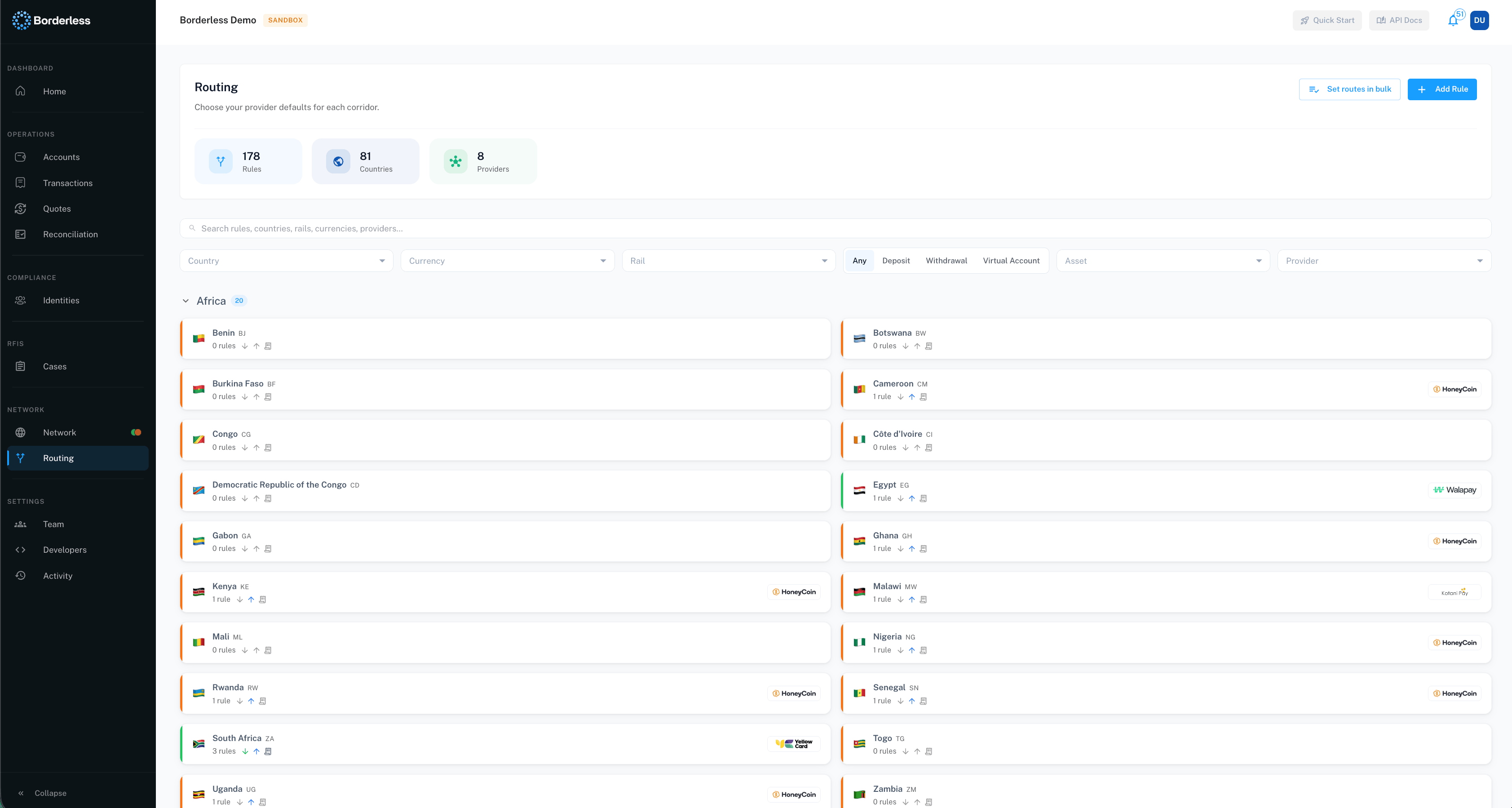
- Rules — total number of routing rules configured
- Countries — how many countries have at least one rule
- Providers — how many distinct providers are used as a default
Read a country’s status at a glance
Each country appears as a card with a colored bar on the left:- Orange — at least one operation your active providers support has no default rule yet. Transactions for that operation will error.
- Blue — every operation has a default, but at least one rail-level override is layered on top.
- Green — every operation has a default and there are no overrides.
Open a country’s rule list
Click any country card. A panel slides in from the right showing the country name, ISO code, and rule count, with an X button to close it.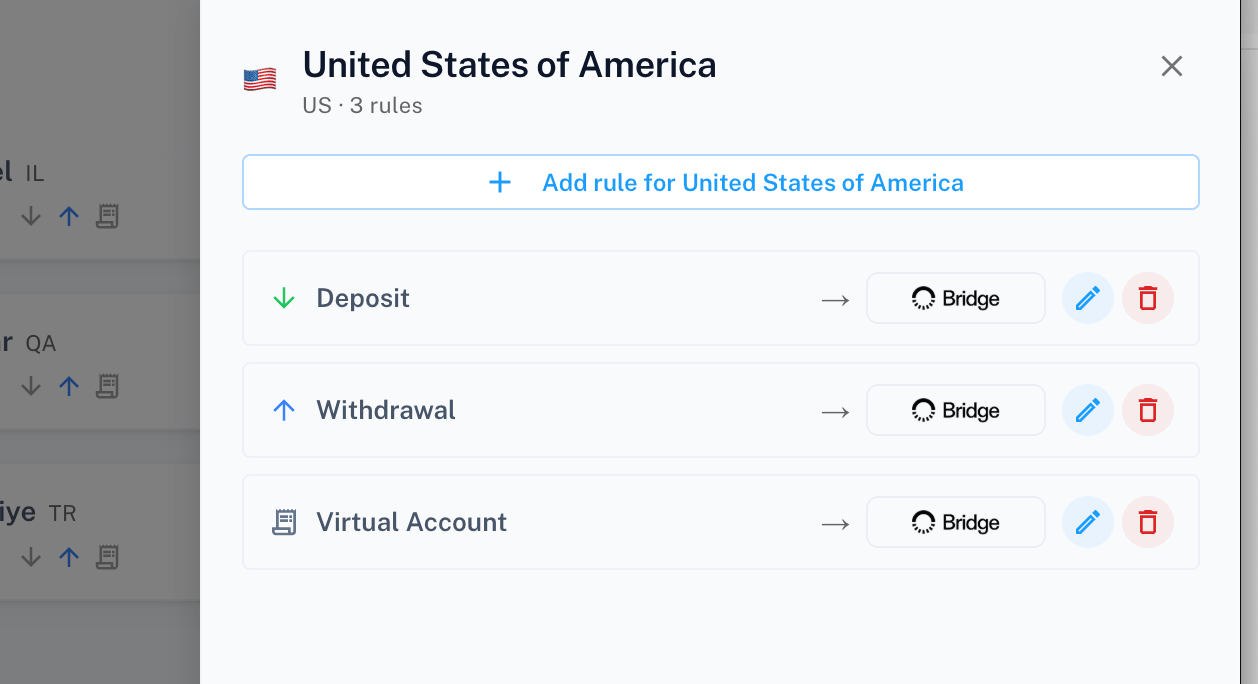
- If a rule exists, you’ll see an arrow, then the provider’s logo or name, followed by edit and remove icon buttons.
- If a row is a rail-level override (for example, a rule that only applies to SEPA), it shows the rail name and an OVERRIDE tag. The rail-level rule takes precedence over the country/operation default for transactions on that rail.
- If no default exists yet for that operation, you’ll see an orange shield icon and “No default set”.
Set routes in bulk
Use this to turn a provider on across many countries in one pass, rather than adding rules country by country. This is the usual workflow when you’ve just enabled a provider: it likely covers more than one country, and a single bulk pass routes everything it supports.- On the Routing home page, click Set routes in bulk.
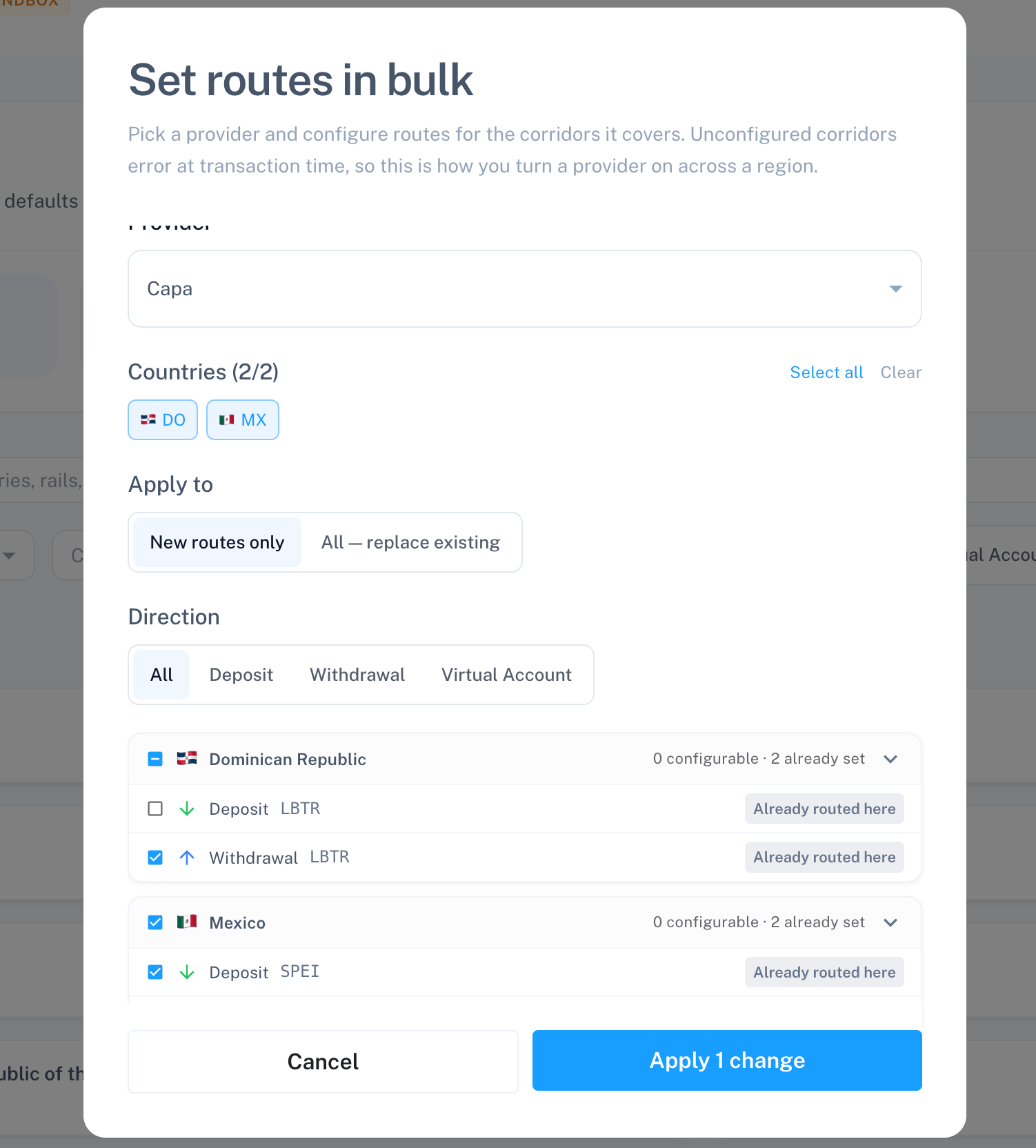
- Choose a Provider. Only providers with active status appear. Until you pick one, the modal shows “Select a provider to see the routes you can configure.”
- A chip list of countries the provider supports appears, all selected by default. Use Select all or Clear to adjust, or click individual chips.
- Under Apply to, choose “New routes only” to skip corridors already routed to a different provider, or “All — replace existing” to include and overwrite them.
- Under Direction, filter the corridor list by All, Deposit, Withdrawal, or Virtual Account.
- Check the boxes for the corridors you want this provider to handle. Each row shows a status:
- “No route configured” — nothing is set yet.
- “Replaces {ProviderName}” — a different provider currently handles this corridor. Only selectable in “All — replace existing” mode.
- “Already routed here” — this provider is already the default. It’s checked by default. If the row is backed by a rail-specific override, unchecking it removes that override. If it’s backed by the country-level default and the operation has more than one rail row, unchecking just one of them leaves the country-level rule in place — you need to uncheck every row for that operation to remove it, and nothing tells you a partial uncheck didn’t take effect.
- Check the summary banner — it reads “Apply {n} change(s) for {Provider} — …” with the route and country-default counts.
- Click Apply {n} change(s).
Add a routing rule
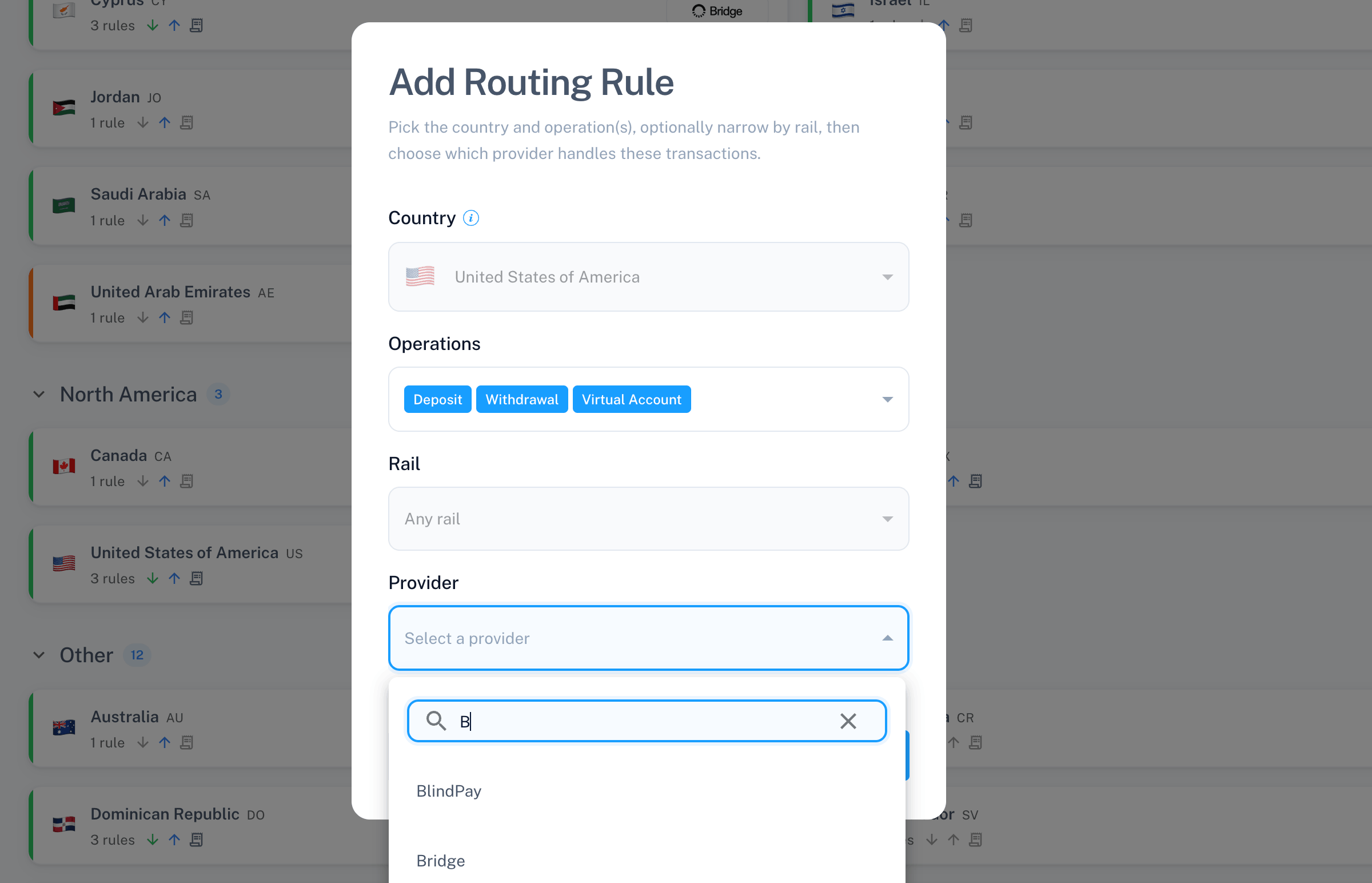
You can start this from two places: the Add Rule button on the Routing home page, or Add rule for {Country} inside a country’s drawer (the second option pre-fills the country for you).- Click Add Rule (or Add rule for {Country}).
- If the country field is empty, choose a country. Only countries your active providers actually support appear in this list — you can’t create a rule for a country/provider combination that isn’t live.
- Under Operations, select one or more of Deposit, Withdrawal, or Virtual Account.
- Optionally set Rail to narrow the rule to a specific rail (for example SEPA). Leave it on “Any rail” to set the country-level default. If you selected Virtual Account, the rail field is disabled and shows “Not used for Virtual Account” — virtual accounts don’t have a rail.
- Choose a Provider. Only providers that can handle every operation you selected, for that country and rail, appear here. If none qualify, the field shows “No active provider supports this” — try removing an operation or rail to widen the options.
- Click Add rule.
Edit a routing rule
Click the edit icon on any rule row in the country drawer. The modal opens with the title “Edit Routing Rule”. You can only change the provider. Country, operations, and rail are locked — to change what a rule applies to, delete it and add a new one instead. Click Save changes to confirm. You’ll see “Routing rule saved.” on success.Remove a routing rule
Click the remove icon on a rule row. A confirmation modal titled “Remove Routing Rule” asks you to confirm, naming the country, operation, and rail (if any). Click Remove to delete it. You’ll see “Routing rule removed.” on success. This can’t be undone — there’s no restore option. Once removed, that operation reverts to having no default (or falls back to the country-level default, if the deleted rule was a rail-specific override).Search and filter
A search box above the country grid lets you type to match rules, countries, rails, currencies, or providers directly — its placeholder reads “Search rules, countries, rails, currencies, providers…”. Below it, six controls narrow the list further:- Country, Currency, Rail, Asset, and Provider — each a multi-select; pick as many values as you need in any of them.
- Direction — a tab group with Any, Deposit, Withdrawal, and Virtual Account; select one to narrow the grid to countries with routing coverage for that operation.